Sunset in Coron

Sunset in Coron
Coron, Palawan

Tuesday, March 5, 2019

PALACIO DE MEMORIA (Part 1)


For many years, I have always wondered about that house at the southwestern end of the Roxas Boulevard that seems to have been forgotten by time. It stood desolate for many years as far as I can remember. But I have always dreamed of  climbing up to the mirador of that house and look out towards the sea. That area of Tambo, Paranaque and further down towards Cavite was the resort area of yore. The "irasan" salt beds were located there as well as "baklad" (make-shift bamboo rafts with extended poles where fishing nets were attached) could be seen along the shoreline and estuaries.


And then after a few years the reclamation happened. The ocean was pushed back a few hundred hectares more and urban development came up in that area. It spurred more recreational activities of a different kind. Casinos, hotels, shopping malls mushroomed in Baclaran (a derivative of baklad) and Paranaque while an expressway was built towards Cavite. No one knows exactly who owned the two-storey  Spanish colonial revival house that sits on a three hectare plot of land. It had miraculously survived World War II.  After the war, the house was acquired by the Villaroman Family.


The Villaroman's patriarch was Don Francisco who was a physician, surgeon, and professor at the University of Sto. Tomas' College of Medicine. It was at this time when the home was renovated and added upon. Washrooms were added near the foyer on the ground floor. Another staircase was installed for Dr Villaroman's patients. And an elevator was installed much later for Dr. Villaroman who had suffered a stroke in his later years. All in all, five more floors rose up over the original house to accommodate the children and their families including a mirador (view tower). The interiors were given a fresh touch with Filipiniana motiff. The terrazzo tiles of tinikling dancers are outstanding! And supporting pillars were included for added support of the upper floors.


I met a former occupant of the house through my good friend, June Recto, who had this very sociable matron client. She was a very gracious lady... very generous with praise and quite unassuming despite her stature. I called her Tita Cora. It never occurred to me that she was a Villaroman. In any case, I lost contact with her over the years. I have no clue as to her whereabouts But I remembered her on a recent visit to Palacio de Memoria (Palace of Memories) which they once owned.

Eventually this jewel of a mansion was acquired by the Lhuiller Family who lovingly restored the mansion to its former glory (if not better; as no one exactly knows how it looked like prior to its acquisition). Plans are afoot to make Palacio de Memoria an art hub/events place/swank cafe. For now, it is home to Casa de Memoria - an auction house of select objects' art. The glorious Murano chandelier at the foyer with blooming roses is an eye-catcher. Even the toilets had valuable antiques. 


We marveled at the collection to be auctioned off on the 9th of March, 2019. It is a motley collection of silver ware, religious statuary,  furniture, fine china, paintings and curios. The Titos N Titas group took  time poring over each and every item; taking selfies and groufies at certain spots and posing for pictures whenever we felt the urge to just click the shutters of our cameras. We were at 95 Bayview Drive, Tamarao Village at ten in the morning. By the time we loaded up for our lunch stop, it was way past lunch time.


One word describes the collection - astounding! I fell in love with a few choice pieces which I would have wanted to acquire. But guess what? If you have to ask... You can't afford it!

my favorite pieces


Tuesday, February 19, 2019

BALLET PHILIPPINES' ROMEO AND JULIET


I just love it when all the elements of a ballet come together to deliver a marvelous performance. It's like the universe aligned and made sure the Saturday evening show came out near perfect . I'm not biased. I just think Ballet Philippines' valentine offering had the makings for a great date night. 

Teacher Perry Sevidal, National Artist for Dance Alice Reyes and myself

How can you not watch? With choreography by National Artist for Dance Alice Reyes, Set and costumes by National Artist for Theater Design Salvador Bernal,  music  by Sergei Prokofiev as played by the Manila Symphony Orchestra, and lighting design by Katsch Catoy; Romeo and Juliet's classic love story comes alive in dance form. 

Denise Parunga and Joseph Gatti (photo from Joanne Ko dela Calsada*)

Prokofiev's music can be over powering as it is. One can literally just close one's eyes and listen to its haunting theme completely ignoring the artists onstage. But you see, the choreography enhances every peak and valley of the score that you sit glued to your chair until the curtains are drawn for intermission. It helps that lead stars Denise Parungao and guest artist Joseph Gatti are so engrossed in their characterization added to their strong technique. Gatti's leaps and pirouettes are immaculate and his lifts are so secure, he can do a pressage (overhead lift) with one arm. Denise Parungao delivers as the tragic Juliet; a young lady in the throes of womanhood. She has come a long way in her dancing. Her pirouettes come without hesitation and she lands ever so softly in her leaps  you can barely hear the clik-clak of her pointe shoes. Maybe it helps that she is engaged and she has much emotion to draw from. Whatever it is, the two leads have a chemistry that was evident in their past partnering in Don Quixote that is as strong as it is now in Romeo and Juliet.

Lady Capulet * photo from Joanne Ko dela Calsada
Perry Sevidal, Liza dela Fuente as the nanny< and myself

Good friends Liza dela Fuente (as the nanny), Butch Esperanza (as Lord Capulet) and Joanne Ko dela Calsada (as Lady Capulet) add able support in portraying integral characters to the ballet. Joanne's stately disposition as the prim and proper, if overbearing mother to Juliet is the perfect foil to Liza's nanny character- a comedic and clumsy role that isn't easy to pull off. I'm glad they accepted the roles assigned to them. Butch Esperanza was quite a revelation. Except for his kayumanggi skin, he was convincing as the lord of the Capulets. He was able to move me as the grieving father who finds his lovely daughter lifeless in her bed egging me to rib my seatmate Perry Sevidal with a joke : '"marunong pala umarte si Butch?" (Butch can act?) He needs to lighten his skin tone, though... The Juliets are fair skinned and Gatti is pale as evidenced while dancing sans shirt in the bedroom scene.

Curtain call photo by Willie Aquino*

The young corps de ballet, I think, needs more classes in mime and acting for ballet. I barely sense the tension among the Montague and Capulet followers in the sword fights among the men and cat fights among the women. They almost seemed like kids attending a children's party on their way to the ballroom scene. They have to have adapt a more elegant characterization. Meanwhile, Mercutio (EJ Arisola), Benvolio (Victor Maguad) and Tybalt (Eugene Obile) rose to the occasion as friends and rivals. EJ delivered good acting prowess as the jokester that laughs his way to his death. Victor's curly mop head is a little distracting to his clean dancing. Eugene is the arrogant Tybalt who towers over everyone else. The Tybalt character requires seething passion to portray a hatred for the rival clan and a longing desire for Lady Capulet's amorous attention.  Their dancing was none the less great. The dancing and the mindset have to gel into one character.  I have yet to see the alternate cast perform, though. Let's see who does it better...

maquette of Badong Bernal's mausoleum set

Badong Bernal's set is as imposing as ever. This is his gift. He can make the CCP stage as grand as he wants it to be. I somehow remember his sets for this ballet a little darker, more somber than this version. The set, on its own, had a sense of foreboding. This one, taken from original plans has a lighter pallet and then the rafters in the market scenes was too flat. It lacked  the texture and grain of heavy wood. Katsch's lighting saves it with amber tones and we like the well lit ballroom and bedroom scenes. The faces and expressions could be clearly seen and the mausoleum lighting enhanced the looming candelabras and statues. 

Denis Parungao and Joseph Gatti at curtain call photo by Willie Aquino*

I have yet to watch the alternate cast of Jemima Reyes and Monica Gana and Victor Maguad and Ronelson Yadao essay the lead roles. I wonder what else they could bring to the table. Thankfully, they have another series of shows this coming weekend. Go catch it! You might fall in love all over again...

Wednesday, January 30, 2019

Marketing MiraNila!


MiraNila photo from MIraNilaOfficial.Home*


It's been a while since I've posted a new entry on my blog.  I've been putting it off since I wanted to give some privacy and space in deference to the Benitez family before the official launch of MiraNila as an events and wedding venue. But today, I was invited to a meeting at MiraNila by the owner and staff of Bizu and their suppliers before they dive in full scale into operations.
The Alcove
Bizu and the Benitez family have made a partnership that will eventually make MiraNila a hip place to be in. Yes, this genteel mansion done in the Florentine style will soon be opened to the public for very special occasions such as weddings, christenings, anniversaries, birthdays, exhibits, product launches, conferences and seminars. The sprawling villa, once the ancestral home of the prominent Benitez clan has agreed to host your intimate parties with sumptuous food catered by no less than Bizu including a tour of the home (made upon request).
the manicured Garden with the Pavilion and CoffeeShop
Our initial visit with my friends from the Advocates for Heritage Preservation namely; Annie Grace Nicandro Obeya and son, Jace, Mabelle Tenorio, Fritzie Ramos, Yohann Moises and moi were greeted by Bizu sales manager Kate Nopuente and members of the Benitez women. We were ushered in by Ms Petty Johanot and Ms Delia Pineda into the home. As passionate heritage lovers, we inspected every nook and cranny of MiraNila as Ms Petty delighted us with stories of their family gatherings and her years as a member of the Bayanihan National Dance Company. We are grateful for that privilege. 
View of the garden from the upstairs room
Today's meeting was of an entirely different nature. Bizu is getting down to the brass tacks to get a feel of the property and to establish the flow chart once they open MiraNila's imposing arched gateway to the public. Standees have been placed out front to indicate the exact location. On the initial plans, the Garden, with its ancient trees may serve as a reception area for big events. The property also has a Pavilion that may be converted as an exhibit hall cum party venue for up to a hundred fifty guests. The Formal Dining Room is reserved for premium bookings of very, very, very intimate affairs.
the Pavilion
I showed staff and suppliers around the house and made a few more recommendations to protect the artifacts and items that can be found within. You wanna see the mansion? You have to pay a small amount to cover the tour. Only a limited number of people will be accommodated per tour each day as they are very careful to limit the carbon footprint into the home. But while you're waiting for your turn, you can sample Bizu's cakes and pastries in a coffee shop that will be set up in the grounds. A museum shop is still in the works.   I can assure you, dear readers, that every cent is worth it. You may call Bizu for further inquiries. In the meantime, a formal launch and announcements will be made even before you can even say "MiraNila!"

Historical marker


Thursday, October 4, 2018

DOING DRESSAGE


It's been decades since I've attended an equestrian event. Three decades, actually. So when a friend invited me to attend a dressage event at the Manila Polo Club, I jumped at the opportunity to attend with them.

In my excitement, I left early to avoid the traffic at McKinley and set out to meet them at the rendezvous spot which was the Sanctuario de San Antonio at Forbes Park. The serenity of this Franciscan church belies the privacy of the community it serves. At the day of my visit, I spent time waiting for my friends at the parish office while weddings were taking place at the church. 

Well manicured gardens and seating areas near the community center had some human traffic and the flashy cars of both parishioners and wedding entourage were coming in and out with some regularity. The community center was obviously reserved for various activities of church organizations, you could hear the choir vocalizing in one of the upper rooms. At around the time I had decided to attend anticipated Mass, the invitees to the dressage were close by to pick us up.


It took all of five minutes and a few short turns to get to Manila Polo Club. An immediate turn to the right after the guard post and we were at the paddocks and stables area. Just as I remembered where it would be... I wasn't surprised to see a handful of spectators at the riding arena. After all, any equestrian event in this country is reserved and appreciated only by the very, very rich.

Dressage is a French term , most commonly translated to mean training, is a highly skilled form of rodong performed in exhibition and competition, as well as an "art" sometimes pursued solely for the sake of mastery.

Given the above definition, a rider and his horse starts out at the beginner level and goes through six other levels before they can reach the major tournaments as specified by the Federation Equestre Internationale, the international governing body for these events. After passing through these levels, they can, provided they become masters of the art move on to international levels of competition. The "small tour" has four categories: The Prix St. Georges, Level 1, Intermediate 1, Intermediate A and Intermediate B.  The "big tour" has three levels: Intermediate II, Grand Prix and Grand Prix Special.


Dressage is not a flashy event. Unlike show jumping, dressage is more like a drill. Think of it as a pas de deux between horse and rider. The rider directs the horse to go through a standard set of drills or steps given a specific time frame. Based of how well they complete the standard passages given, they are given a score ranging from zero to ten by each of the judges. So basically, the competition standard  is set not among the competitors but on how well each one completes the tasks. The competitors, although seeking a better routine than their counterparts, are more concerned on how their mount can do better for themselves.

On this given afternoon, there were four  who executed the standard gaits from walks, to trots, to canter... They never ever go on a full gallop. Set against the lush greenery of the Polo Club and the setting sun, the participants went through the necessary paces to accomplish the tasks at hand. It ended all too soon since there were just our group of six people, the four riders and their horses and just a few relatives of the participants ( whose family names sound like Manila's who's who). They were even surprised to see us watching the event. 

After exchanging some pleasantries, we made our leave and eventually came across former Foreign Affairs Secretary Alberto and Mrs. Romulo. We did the same thing asking to be photographed with the honorable couple as we did earlier with the riders. As quietly as we came in, we left the area and made our way back to EDSA where I took a ride home. Alas, I was born on the other side of the paddocks...

Thursday, September 20, 2018

CARMINA BURANA

photo from Ballet Philippines archives*
When the curtain rises in a ballet production and there is no set, it can only mean one thing - the medium is the dance!

Such was the case in Carmina Burana, Ballet Philippines' opening salvo for the 49th Season. I attended the performance on a Saturday evening not expecting anything. Having trained and performed as a dancer with the company for many years, I know in my heart that all of the company's productions would be nothing short of spectacular. Was I surprised that they outdid themselves this time? Certainly!
Ronelson Yadao's Sama Sama; photo from Ballet Philippines archives
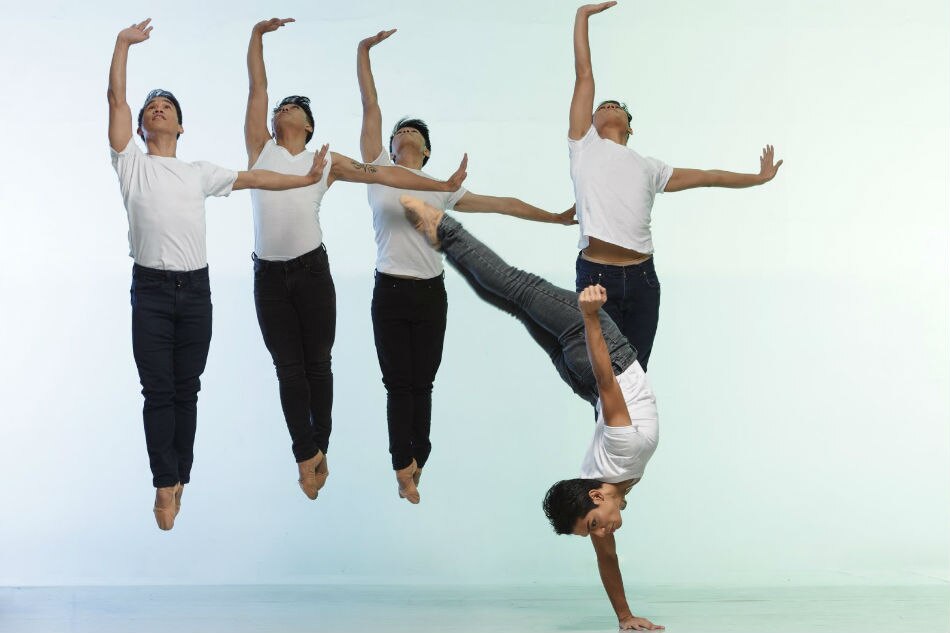
The show opened with Ronelson Yadao's choreography; Sama Sama, highlighting the company's male ensemble. It was a light-hearted piece showcasing how far the company's male dance technique has progressed this far. Very simple costumes in white tees and black jeans, undermine the fluidity and strength the men of Ballet Philippines has achieved. These guys are all young and at the height of their virility and they make the steps look so easy. That's the choreographer's trick! You really can't tell if the dancers are just hamming it up or just winging it... And boy, were they enjoying it. I can't help but notice how some of the dancers have improved. Danilo Dayo and John Ababon have earned their solo parts, I'd say. Even the male apprentices have managed to keep up with the principals in a fun, energetic number. Can't help but notice how Yadao also managed to incorporate some folk dance steps into the movement. The Coconut Nut segment was a noticeable ode to a "Maglalatik" deconstruct. This piece was a great curtain-raiser, I wouldn't be surprised if they included it as part of a repertoire for a tour.
Brando Miranda's Vivaldi Concerto; photo from Ballet Philippines archives*
Brando Miranda's Vivaldi Concerto, on the other hand, showcased the company's mettle in neo-classicism. Three couples performed in ensemble work and pas de deux. Katrene San Miguel, Monica Gana and Sarah Alejandro and respective partners Erl Sorilla, Lester Requindin and John Ababon flitted in and out of the stage with ease exhibiting nearly flawless partnering. The women sparkled in this piece enabled by the danseurs' steady support. Katrene was her usual "coquettey" self.  Monica was a picture of innocence and naivete. And Sarah was the strong woman of the world. Each of the ladies performed with great aplomb never faltering with their pirouettes en pointe. It helped, of course, that their partners never let them down. Some of the lifts were very risky but there were no second thoughts in their execution. The pressages and some overhead lifts made my heart skip a little bit but they were saved at the last minute which would have been unnoticeable to the trained eye. The piece ends as it began, all six dancers dancing together to guitar soloist' Aaron Biag's  melodious strains. Brando's  choreography remains as light and entertaining as ever.

Ronelson Yadao in Season of Flight; photo from Ballet Philippines archives*
Season of Flight by Norman Walker was first performed in June 1972. An abstract piece taking its inspiration from the movements of birds, this piece has been performed by the company to critical acclaim in its world tours. For this performance, the leads were ably performed by Ronelson Yadao, Eugene Obille and Jemima Reyes. It's refreshing to see Jemima dancing barefoot for a change. For once, she's not en pointe! We know she can be fearless when she's literally on her toes but dancing opposite Ronelson who is an accomplished modern dancer, she manages to stand her ground. Great casting for this one, really. The two have a chemistry that isn't hard to miss. Eugene Obille as the third wheel is a looming presence with his huge frame.  This is the piece that prepares the viewer for the piece d' resistance of the evening.  The younger company members form the corps d' ballet have been given the task of dancing in a Norman Walker choreography and they imbue the piece with a youthful quality that was less... heavy...

Carmina Burana by Alice Reyes, photo from Ballet Philippines archives*
After the interval came Alice Reyes' Carmina Burana.  Now, I'm not afraid to say how fortunate these young dancers are. Many years ago, as a young dancer being launched with the very first junior company called Ballet Philippines II, the other dance scholars and apprentices had to learn the Taberna section of Carmina Burana. We never got to perform it, though. Last minute changes had to be made and eventually the seniors did the piece for us. Decades later, Carmina Burana is  resurrected for the 49th Season to the delight of newer dancers and newer audiences alike. 
Carmina Burana; photo from Ballet Philippines archives*
Carl Orff's oratorio is a strong piece on its own. It has stood as an independent piece of music for centuries. Used as background music to highlight cinematic scenes, audiences are more familiar hearing Carmina Burana in epic battle scenes for big budgeted movies.  The company's principals and soloists were used to full effect on this choreography. Denise Parungao, Jemima Reyes, Sarah Alejandro, Ronelson Yadao, Victor Maguad, Lester Requindin along with the corps delivered the goods.  Writhing, nubile bodies either sporadically exploding in movement in scattered sections or moving in unison as one collective mass of human flesh, Alice Reyes mastery in choreography comes to the fore. She's able to relate a story using dance as a narrative... if only for this, then she deserves her title as National Artist!

Kudos also goes to the musicians that went along on this journey with the company. It was a tough repertoire to play and sing. The ABS-CBN Orchestra, Philippine Madrigal Singers, Our Lady of Fatima University Chorale, Kilyawan Boys Choir, guitarist Aaron Biag, baritone Noel Azcona and coloratura soprano Ma. Cristina Viguila- Navarro all had a share in making it a memorable evening. It was obvious that conductor Gerard Salonga has moved away from the shadow of his famous sister. He manages to steer his musicians to create moods for his audience with his artful musical direction. Lyrical pastoral scenes, almost comical pop tunes, reverberating choral crescendos all blended together with passionate dancing to climax into one brilliant performance. The only move-able set piece for Carmina Burana was a reconstruction from National Artist Salvador Bernal's original design. Apparently,  this set has remained as timeless as the dance piece. Everything comes together with exceptional lighting design from Katsch Catoy, no less.  The dancers' bronze skin is highlighted by soft amber while the set glows in fiery red in some sections. I just love it when all the elements come together in a cohesive performance.

Hold on to your season tickets, folks! Ballet Philippines'  49th Season  has only just begun...


*Official photographers for Ballet Philippines are Jojo Mamangun and Justin Alonte

Monday, September 10, 2018

NATURE TRIP WITH MAGSAYSAY AWARDEES II


It just recently occurred to me that I have never written about the National Museum of Natural History. This is the perfect time to do it since I am showing the rest of the  awardees around the museum for the entire morning. On this tour were the awardees and their companions, the security detail and the rest of the Ramon Magsaysay Award Foundation staff involved in the tour.

Maria de Lourdes Martins Cruz of Timor Leste was one of seven children born to a coffee planter. She studied at a Jesuit school in Yogyakarta, Indonesia and eventually joined the Canossian Sisters but left before taking her final vows. She felt her calling was outside of the convent walls. She founded the Instituto Seculare Maun Alin Iha kristo (ISMAIK) that was dedicated to uploifting the poor through projects in health care,education, farming, animal husbandry, and other self-help initiatives. Notwithstanding the conflicts between the Indonesian and Timor-Leste militant armies in liberating the country from Indonesia, Mana Lou (as she is fondly called), crossed military lines and talked to Indonesian soldiers and refugees spreading a message of peace and solidarity and was allowed to establish a place of refuge in her father's coffee estate. eventually this was to grow to include a school for girls, orphanages, homes for the sick and a place where people of different religious beliefs and politics could find safety and peace. Her work has magnified into seven houses all over Timor Leste which is run by volunteers and are now referred to as "schools of life".

The simplicity of her approach to needs based problems has been effective in alleviating the plight of the poor in Timor Leste.

Vo Thi Huang Yen of Vietnam was born and raised in a remote village in Vietnam's Dong Nai province. Beset with polio at two and a half years of  age,  she refused to become  a dependent  due to her condition and rose above her malady. She pursued a degree in Agricultural Economics and also in Education from the Ho Chi Minh University. She also received a scholarship from the University of Kansas where she received a graduate degree in Human Development. Turning her back on opportunities in the U.S., she returned to Vietnam. These degrees tucked under her belt did not give her an advantage in her homeland. She was turned down in her first job application due to her condition. From then on, she established the Disability Research and Capacity Development (DRD) with three other persons with disability; whose aim was to create  an equal and non-discriminatory society for PWDs, To date, the DRD has helped  assist some 15,000 PWDS with skills and capacity building activities, scholarships, job placements, donations for assistive devices and computers, and using social media, a website on laws for the disabled, and a digital map showing PWD accessible public buildings.

She has recently obtained a doctorate degree from La Trobe University in Australia while directing activities of the DRD in Vietnam. Her inclusion in this year's roster of awardees affirms that her selfless dedication to improve the lives of the disabled, and increasing the opportunities for them in  Vietnam. 

Bharat Vatwani from India, is a psychologist by profession. Dining out with his wife one evening, both witnessed a  thin, unkempt, mentally ill person drinking water from a canal. They talked to the man, a mentally-afflicted college graduate,  took him to their clinic to be washed and treated and reunited him with his family. This led to the establishment of the Shraddha Rehabilitation Foundation in 1988 aimed at rescuing  mentally ill persons living on the streets, providing free food, shelter and psychiatric treatment and eventually, returning them to their families. Starting with a 2 bedroom tenement house, they could only treat three people at a time. However, their work became public when they unknowingly treated a street person who was a Mumbai art professor who suddenly disappeared. Learning what the Vatwanis had done the school's faculty and students organized an art exhibit that raised US$22,357.00. The Vatwanis used this amount to buy property in Mumbai for a 20 bed facility in 1997. Private and corporate donations started to come in that helped them expand their work. By 2006, they have expanded operations to a 120 patient facility that spread in a 6.5 hectare property and had 5 buildings. They are now aided by police, social workers, and referrals. Their services range from personal hygiene, medical check-ups, psychological treatment, all done in the Karjat facility where they can engage in simple farming activities and in the multi-religious meditation center. 

Mr Vatwani's work comes as a much needed "shot in the arm" in rescuing the mentally ill destitute patients which are literally scorned by Indian society.

Sonam Wangchuk also from India comes from the province of Ladakh. He was one of the many children of a local leader, he had a difficult education  due to discrimination of minorities in the Kashmir region, schools lacked teaching equipment, teaching standards were poor, textbook content was locally irrelevant  and the medium of instruction was alien in the mountains. An engineering student at  the National Institute of Technology at 19, he tried to support himself by offering tutorial services to other students who were preparing for the national college matriculation examinations. Renting a hotel function room he advertised a coaching program that drew close to a hundred students. After graduating from  an engineering degree, he founded the Students' Education and cultural Movement of Ladakh (SECMOL) and started coaching Ladakhi students, 95% of whom used to fail the government exams. Piloted in a village school, the program involved training teachers in "creative, child-friendly and activity based education", introducing curricular changes to make subjects relevant to Ladakhi culture and context, prioritizing English over Urdu to prepare students for higher education and promoting the Ladakhi language. Event tually the program was adapted into 33 schools and became a veritable movement. He established the Operation New Hope in 1994 to expand and consolidate the partnership-driven  educational reform program.The program has already trained 700 teachers, 1,000 Village Education Committee (VEC) leaders. and dramatically improved the success rate of  students in matriculation exams from a mere 5%  in 1996 to 75% in 2015. in 1998, he opened the SECMOL school with a permanent faculty, volunteers, 300 students.  It is an alternative boarding school that also offers review, certificate and associate-level courses, rebuilds student confidence, develops life skills, revisits  the fundamentals and offers courses ranging from leadership training to solar power installation. His ideas and model programs have been adapted in educational systems in the Himalayan Belt as well as Switzerland.

Mr Wangchuk's contribution to Ladakhi Society underscores the need for adaptive learning and harnessing science and culture effectively to raise learning standards in his province.

We made our way to the National Museum of Natural History after our photo ops at the Rizal Monument and were welcomed at the rear entrance by the administration and staff of the museum and assigned to us was Lau de los Santos. The museum was designed in such a way that it highlights the flora and fauna of our country according to the elevation. Each floor features specimens from the stratospheric to the subterranean. We were welcomed by the president of the museum Mr. Ramon del Rosario. After the necessary introductions and another backgrounder into the museum by  guide Lau, photo ops for the group with the Tree of life as a background they were ushered to the fourth level where the tour was to start.

Incidentally, the museum building was designed by Antonio Toledo in 1930 and was formerly used as the Department of Agriculture and Commerce in 1940. The Department of Tourism  used the building as their headquarters until 2015 and later moved to their offices in Makati City. The building was then donated to the National Museum foundation and retrofitted under the design team of Architect Dominic Galicia and Interior Designer Tina Periquet. 

The rest of the party took the regular elevators and we met them at the gallery entrance. We toured each level dutifully allowing photo opportunities among the awardees as they admired the museum's grandeur. Truly, the Philippines is blessed with its rich biodiversity. From cloud rats, civet cats, bugs and butterflies, flying lemurs and bats, this museum does not fail to impress. At the canopy level were a myriad group of specimens: primates and birds, more rodents, snakes. as went lower through the galleries, we showed the guests the raison d' etre per room. Particularly interesting was the mangrove section and the class showcases for different plants. finally as we got to the ground level, we were ushered into the atrium where the skeleton of Lolong was displayed.  Along within that room were the recent discoveries of rhinoceros bones and arrowheads. These archeological discoveries displace the Tabon man as the earliest inhabitants of the Philippines. These remains date back 700,000 in our history.

Mr del Rosario requested us to view a short audio-visual presentation on the ground floor and then made the special announcement that the galleries that were still closed off to the public was available for us for special viewing. What a treat! I won't spoil the anticipation of those who want to see the closed galleries when they open so let's just pretend I didn't see anything...

After the closing commentaries. the party made its way to Greenbelt 1 in Makati for a sumptuous lunch hosted by the family of fellow awardee Mr. Howard Dee at Peking Garden. Special dishes were prepared for those who had dietary restrictions while the rest had crispy fried green salad with almonds, Peking duck breast wraps, mushroom saute, crispy Peking duck bones and a dessert of mango and tapioca. Lunch was a fun affair that lasted to mid-afternoon then before departure, the obligatory phot ops were taken before some of the guests proceeded to Greenhills for pearl shopping and the rests of the guests went to the Mall of Asia and some back to the hotel.


Wednesday, September 5, 2018

NATURE TRIP WITH MAGSAYSAY AWARDEES I

This is the third year I have done guiding duties for the awardees of Ramon Magsaysay Award Foundation. For sixty years now the foundation has ferreted out ordinary individuals who have, in their own simple way achieved extra ordinary things benefiting a larger base of people either from one community, province or country.  I am very fortunate to have done the guiding for them along with fellow Mabuhay Guide Yael Fernandez. This year, though, marks the maiden year that I will be showing them around Manila on my own. Apparently, Yael could not make it on this particular Sunday morning (2 September, 2018).


I have written about the Ramon Magsaysay Awards in previous posts. The institution serves to honor the memory of our third president of the Philippine republic who has distinguished himself as a paragon of socio-political change and moral fortitude. The board of directors of the foundation with Ms. Carmencita T. Abella at its helm gives citations to people whose singular vision, courage and strength have improved the situation, inspired the thinking, and changed the lives of a greater majority. This year's awardees have been conferred the RM Awards for their acts of compassion and selfless devotion to the cause they champion. The awards are given in formal ceremonies at the Main Theater of the Cultural Center of the Philippines on the 31st day of August coinciding with the ;ate president's birth anniversary.
Youk Chhang rreceiving his award (*photo credits to owner)
Officially, the tour started at nine a.m. with a short bus tour to the Rizal Monument for official photos. All the awardees were able to join the tour with the exception of Mr. Youk Chhang of Cambodia who went on a sentimental journey to retrace his steps when he moved to Bataan as a refugee in his younger years. A victim of the Khmer Rouge genocide that lasted from 1975-1979, his family was enslaved by the Khmer Rouge in a rural commune. He experienced torture and witnessed the death of his father, five of his siblings along with sixty of his relatives in the commune. At seventeen he was able to cross the Thai border to freedom and made his way to the United States where he earned a graduate degree in a political science after which he returned to Cambodia after the transition to a stable government to take on the task of documenting the horrors of  the Khmer Rouge regime. 
Mr Youk Chhang  (*photo from Wikipedia)
He has taken on the responsibility of collating vital information, evidence and research and documentation on the horrors in Cambodia during that period. His work has served as a basis for evidence for crimes against humanity and published and digitized for online public access, introduced digital mapping of over 23,000 mass grave diggings and countless interviews with both victims and perpetrators in ensuring that these events are never forgotten and that the future generations will never experience these horrors again. To date, he is establishing the Sleuk Rith Institute which will house a museum, archives, a library, research center; and a graduate program on crimes against humanity to sustain the Documentation  Center of Cambodia (DC-CAM) as a resource center for a world deeply scarred and still threatened by genocide. 

Youk Chhang (*Getty images)
Youk Chhang's personal tragedy not only serves to remind future generations of past horrors but wishes to transform it to a positive force in attaining and preserving justice in his nation and the world.
Mr. Howard Dee (*photo credits to the owner)
Also unable to experience the tour is Mr Howard Dee of the Philippines. Mr. Dee was born to a middle class Chinese family engaged in the lumber business based in Tondo, Manila. After completing his studies at the University of the East, he carved out a name for himself as a successful businessman as a shareholder of  Unilab which was a pioneering local pharmaceutical company. In 1970 he established the Philippine Business for Social Progress (PBSP), composed of business corporations that allotted 2% of their profits for social development.

Eventually, he left Unilab and PBSP and established the Assisi Development Foundation with Jesuit priest Francisco Araneta, S.J. The ADF has saved 10.5 million Filipinos with 4,123 projects. It incubated ASA Philippines in 2004 that has become the largest, best-performing micro-finance institutions in the country. Together with the Catholic Church, they started the Hapag-Asa, a integrated feeding program that has fed 1.8 million Filipino children. He also mobilized a concerted effort among corporate entities, civil society, media and church groups called Tabang Mindanao (Help Mindanao) that served to provide assistance of food, shelter, water systems,  farm support and health and education assistance to families displaced by the drought, armed conflict and deportation of Filipinos from Sabah. The ADF also took up the cudgels for the Indigenous Peoples of Mindanao through legislative and educational assistance, scholarship, leadership training and IP development programs, like the Pamulaan Center for Indigenous People's Education in Mindanao.

Mr Dee's mild demeanor yet, persevering spirit aids him in quietly working to establish a balanced solution to emergencies thus being a conduit to government assisted programs. He has been approached by government to lead peace-building and reform initiatives such as the National Peace Conference (1990-1992),  Peace Talks with Communist Party (1993-1994) and the Bangsamoro Basic Law Peace Council (2015). He has served for five Philippine administrations in four different capacities across sectral and party lines. Mr Dee was our host for lunch but since he was still suffering from a lingering malady. In his stead his children welcomed us and fellow  awardees to a sumptous lunch at the Peking Garden in Greenbelt I.